

Key takeaways:
- Service Logging Is Really a Time Problem
- One Workflow Will Not Fit Every Discipline
- Nursing Deserves Its Own Plan
- Getting Providers on Board
- Making Room to Grow
If you run School-Based Medicaid in Virginia, chances are you are one of one or two people holding the whole program together. Staff are stretched, providers are turning over, and documentation is usually the first thing to slip. Our team works with districts across the state, and the same themes keep coming up. Here is what we are seeing, and what tends to help.
Service Logging Is Really a Time Problem
Providers rarely push back on documenting because they do not care. They push back because there is no time. In a recent Relay survey of about 140 providers, double documenting came up again and again: a note in the IEP system, another in the Medicaid platform, and sometimes a third on paper. When logging takes that many steps, it gets pushed to the end of the day, the end of the week, or the end of the month. Some sessions never get logged at all.
Try this: Ask a few providers where they document today, and count the places. That number tells you a lot.
One Workflow Will Not Fit Every Discipline
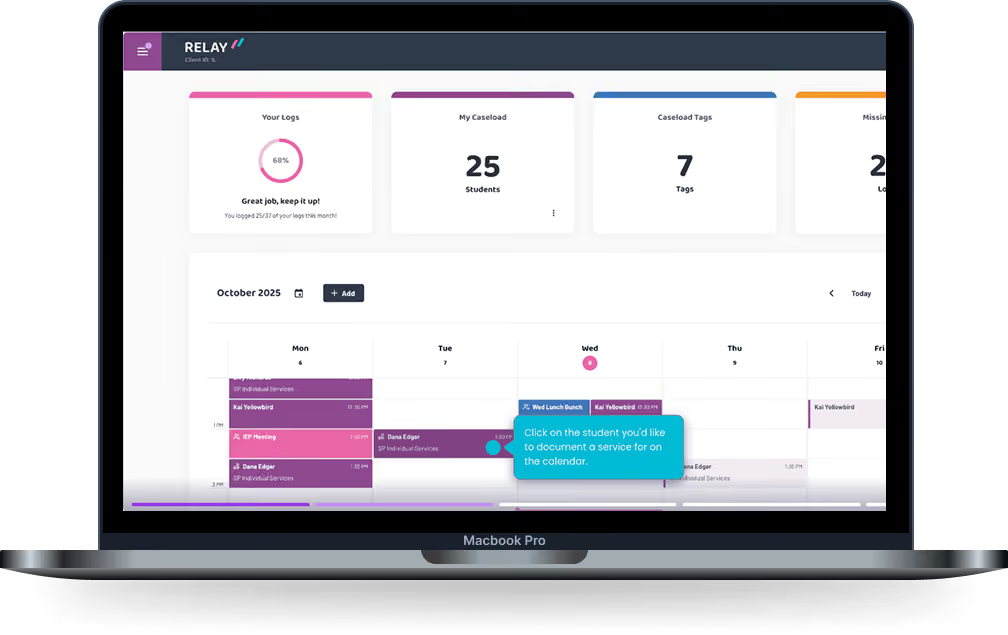
A speech-language pathologist may stay in one or two buildings and see students on a set schedule. A physical therapist may cover every building in the district, with no way of knowing who will be present on a given day. Some providers plan by calendar, some by list, and some document one session at a time. A system that forces everyone into one routine usually gets less documentation, not more.
The goal is flexibility without losing compliance. It also helps to think past the individual note. Supervising providers need to see what they are supervising, and if a provider is out unexpectedly, the person covering for them needs to see what has been happening with each student.
Try this: Ask whether a covering provider could pick up from your current documentation tomorrow.
Nursing Deserves Its Own Plan
Nurses often see more students than any other health service provider, and many of those students are not on an IEP. Their documentation is also different. It happens the same day, because education records are open to parents under FERPA and can be requested at any time.
That should make nursing a strong fit for Medicaid reimbursement, yet it is often left out. In 2023, only 43% of Virginia school divisions (56 of 131) took part in direct services nursing reimbursement, according to a 2024 presentation to the state's School Health Services Committee. Part of the reason is that few people outside the health office know what nurses do or which services are billable.
The other part is double documenting: a nurse who has already documented for every student they saw is not eager to re-enter a fraction of those visits somewhere else.
Virginia's expanded School-Based Medicaid coverage took effect July 1, 2022. Since then, qualifying services can be billed for Medicaid-enrolled students even when they are not listed in the IEP, with specialized transportation as the exception. Those services still have to meet coverage and documentation requirements.
Divisions also need a parent consent process for non-IEP services, and the DMAS Local Education Agency manual spells out what each service needs. For nursing, that includes interventions ordered or prescribed by a licensed physician, physician assistant, or nurse practitioner.
Ongoing behavioral health services need an active written intervention plan from a licensed provider. Some districts do not yet have a documentation system for mental health, and access limits matter because of how sensitive those notes can be.
Try this: Bring your lead nurse into the conversation early. When nurses understand what is billable, they tend to be the ones who grow the program.
Getting Providers on Board
Providers are already health service providers. Documenting is already part of their job, and it helps to say so.
Involve them early and keep training focused on their actual day. Show them the workflow from start to finish, and give them someone to ask when questions come up.
It also helps to talk about the whole picture. Good documentation supports continuity of care, progress reporting, and district-level data, not just reimbursement.
Making Room to Grow
When one or two people run the program, their time goes to checking eligibility, billing, following up with providers, and reviewing notes line by line. That leaves little time to ask what is being left on the table, especially in areas like nursing and mental health. Asking for help does not mean you have been doing it wrong. Start by naming the work you would like to take off your plate, so you can spend more time building the program instead of keeping it afloat.
Better oversight matters here too. Education runs on data, and documentation is one of the few places where many districts cannot easily see who is logging, who is not, and how much time is being spent.
Want to know more? We hosted a webinar on keeping Medicaid on track in Virginia when your team is stretched thin. Watch the on-demand recording.
Every Virginia district we work with has a dedicated Medicaid expert who knows the state and helps build a process that works for the people providing the services and the people managing the program.
Looking to continue the conversation? Schedule a conversation with a Virginia Medicaid Liaison from Relay.
This post reflects what we are seeing and early guidance. It is not legal or billing advice. Please confirm requirements with the Virginia Department of Medical Assistance Services.
Subscribe to Our Newsletter
Get practical tips and the latest insights on special education and school-based Medicaid, delivered straight to your inbox.
Give your team their time back
See how Relay makes special services simpler from the first log to the last claim.