Key takeaways:
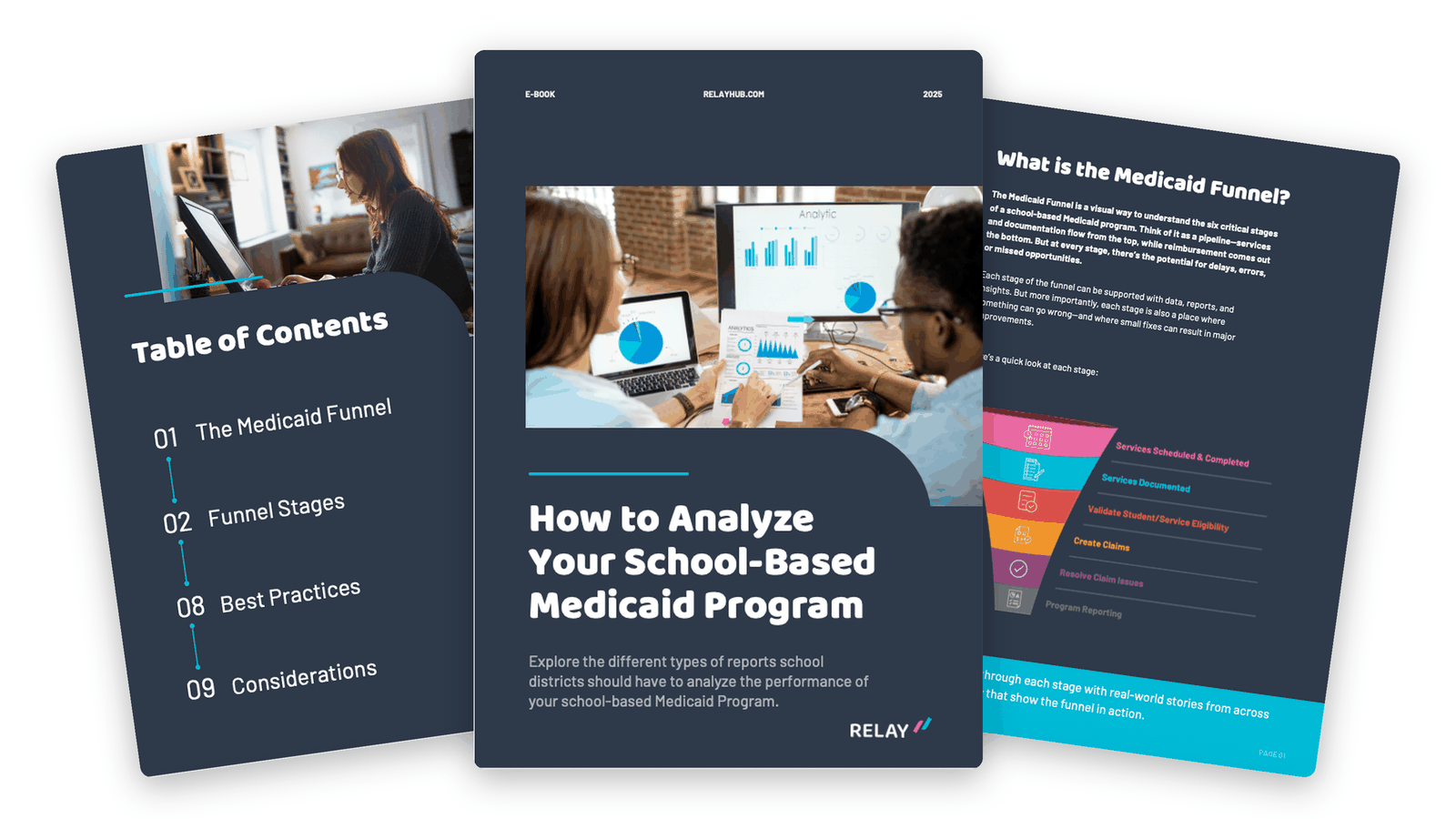
- The Medicaid Funnel breaks a school-based Medicaid program into six stages, from services delivered to program reporting.
- Eight recommended reports, including Held Services and Claim Denials, show where documentation, eligibility, and claims slip.
- Each stage comes with one question your team can ask to find the gap.
- Best practices include quarterly reviews, tracking denial trends, and aligning IEP and Medicaid documentation.
- Working closely with your vendor helps you course-correct and find gaps sooner.
Find Out Where Medicaid Dollars Slip Through
Your providers deliver services every day. What’s harder to see is how many of those services make it through documentation, eligibility checks, claiming, and payment.
This guide walks through the Medicaid Funnel, a way to look at your school-based Medicaid program in six stages. Each stage has a question to ask, a report to run, and a place where small fixes add up.
It’s written for the business managers, Medicaid administrators, and special education leaders who want to know what to look at, and how often.
The Six Stages, and the Question to Ask at Each
- Services Scheduled and Completed. Are students receiving services as prescribed in their IEP? Report: Prescribed IEP Minutes vs. Delivered IEP Minutes.
- Service Documentation. Are providers documenting all services on time, in the right place, and with the necessary details? Report: Review Service Logs in Your Medicaid System.
- Medicaid Eligibility Validation. Are students currently eligible for Medicaid? Report: Medicaid Eligibility History.
- Claim Creation and State Validations. Are services being turned into Medicaid claims, and do those claims meet your state’s requirements? Report: Held Services.
- Claim Submission and Denial Management. Are submitted claims being reimbursed, and if not, why are they being denied? Reports: Claim Denials Report and Pending Claims Report.
- Program Reporting and Financial Insights. Are you using Medicaid data to forecast revenue and guide staffing or services? Reports: Quarterly & Yearly Claim Trends and Financial Reporting for Compliance.
You don’t need to dig forever. Sometimes one provider, one missing consent, or one eligibility record is all that stands between your district and funding you’ve already earned.
Please complete the form to download.
270825d4-9655-48fb-8067-06dee7af534e
how-to-analyze-your-school-based-medicaid-program-delivered